Direct Drive vs. Bowden Extruder: Which one to choose?
The extruder system forms the core of any FFF 3D printer. It directly influences how the filament is fed, the precision of its control, and which materials…
The extruder system forms the core of any FFF 3D printer.
It directly influences how the filament is fed, the precision of its control, and which materials you can 3D print reliably.
Most desktop 3D printers use one of the two setups: Bowden extruders or Direct Drive extruders.
While both of them serve the same purpose, their mechanical design, layout, and behavior while printing are quite different.
In this article, we’ll deep dive into understanding the differences between Bowden and Direct Drive extruders.
We’ll compare their strengths and limitations and help you decide which setup fits your printing needs the best.
What is an Extruder?
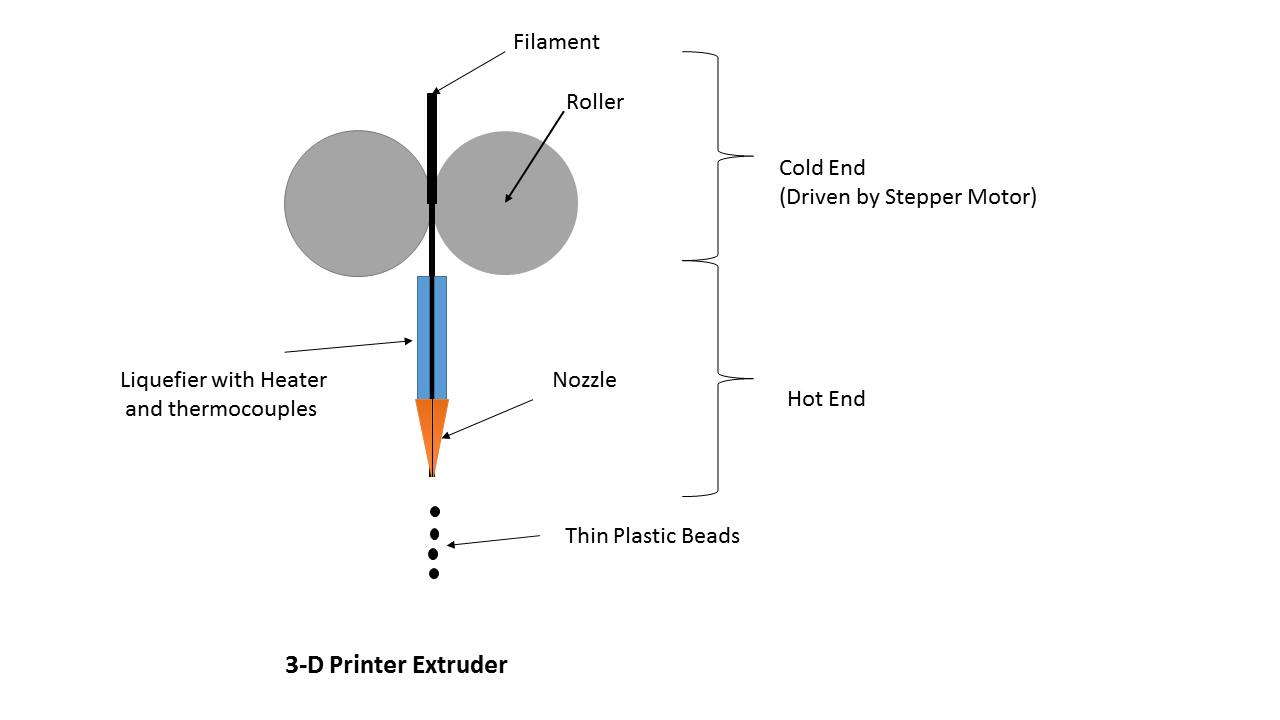
By Priybrat – Microsoft Power Point, CC BY-SA 3.0, https://commons.wikimedia.org/w/index.php?curid=36367670
In the context of 3D printing, the extruder is the motor-driven assembly that grabs the filament and pushes it into the hot end.
It consists of two main sections: the Cold End and the Hot End.
The cold end of the extruder assembly is made up of the motor and the gear that grips the plastic.
While the hotend is the portion where the plastic melts and exits the nozzle.
The simple decision of where to put the motor for extrusion may seem simple, but it changes quite a few things in a 3D printer.
Direct Drive Extruders
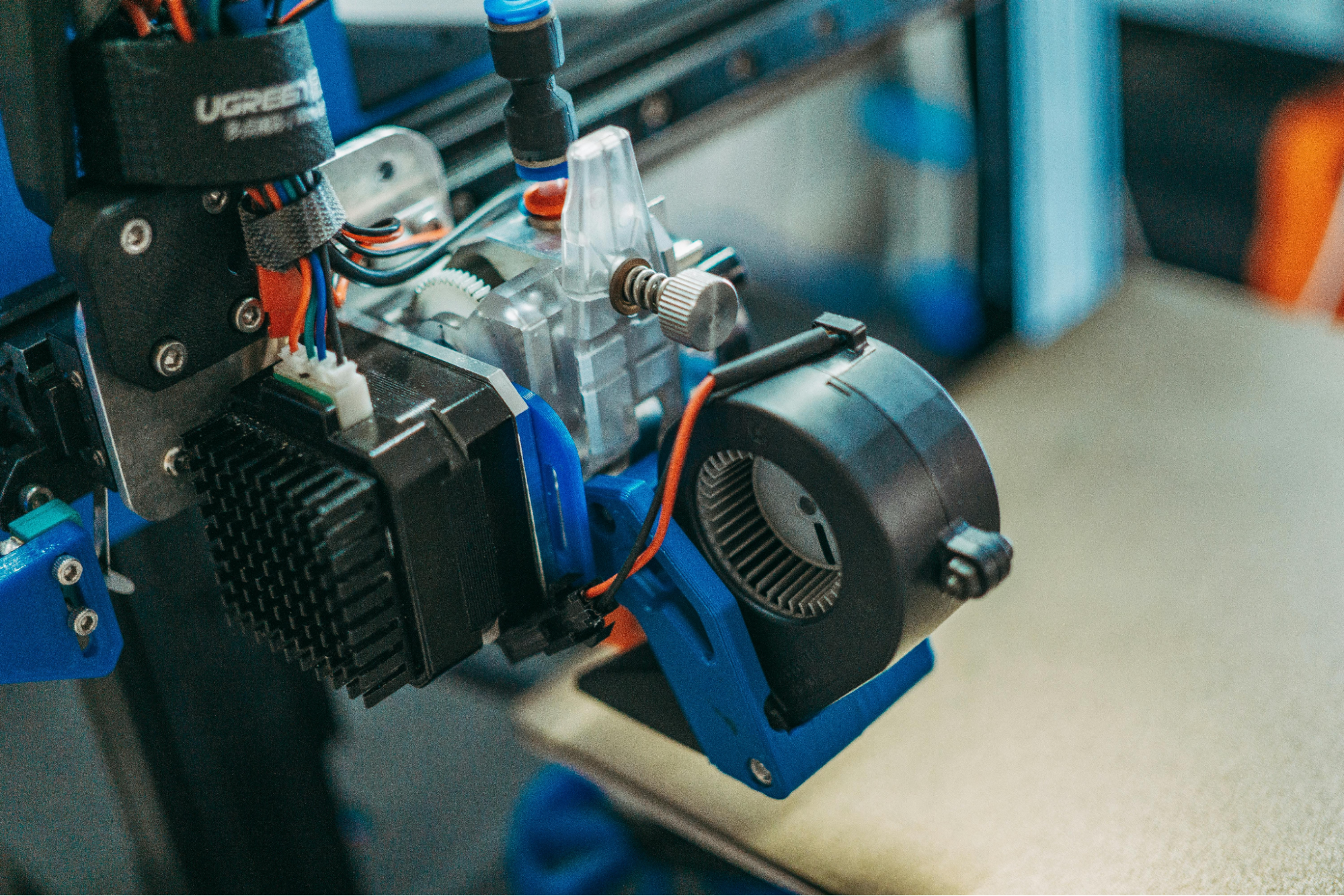
Photo by FOX ^.ᆽ.^= ∫: https://www.pexels.com/photo/close-up-of-a-modern-machinery-13189369/
In a direct drive system, the extruder motor is mounted right on top of the hotend.
The distance between the drive gears and the nozzle is super short, sometimes just a few millimeters.
You’ll see this system on most of the hobby 3D printers sold nowadays.
The Prusa i3 MK3S, Bambu Lab’s A1, and the Creality Ender 3 S3 are just a few of the examples of a direct drive extruder system.
Why Makers Love It:
There are several reasons why the direct drive extruder is the favorite among makers.
Some of these reasons are mentioned here.
Easy to Print Flexible Materials:
As there is almost no gap between the gears and the melting zone, flexible filaments like TPU (thermoplastic polyurethane) have nowhere to bend or “bunch up.”
It’s like pushing a stiff wire through a straw vs. trying to push a wet noodle.
Better Retraction:
Since the motor is right there, retraction (pulling the filament back to prevent stringing) is instantaneous and more effective.
Better Torque:
The extruder has a very tight grip on the overall filament movement.
This makes it easy to calibrate the extruder multiplier and also makes the filament flow more reliable.
The Downsides:
The one significant drawback of a direct drive extruder is its weight.
Moving a heavy motor back and forth can cause “ghosting” or “ringing” on your prints if you try to 3D print too fast.
This problem affects all the i3-style printers as well as CoreXY 3D printers like the Bambu Lab P Series.
The Bowden Setup
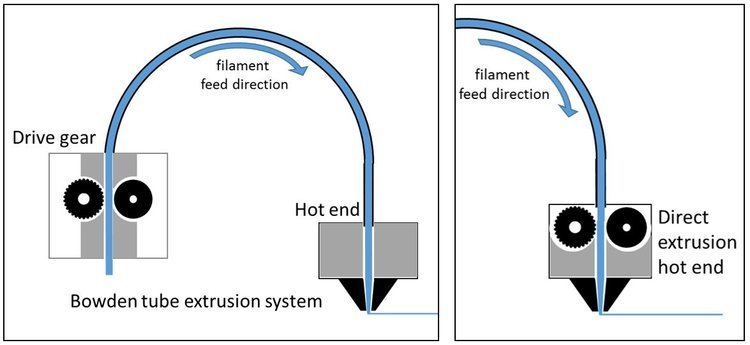
Daniel Ahlers via Research Gate https://www.researchgate.net/figure/Left-A-Bowden-extruder-with-the-feeder-the-Bowden-tube-and-the-hotend-Right-A-direct_fig3_335542650
In a Bowden system, the heavy extruder motor is mounted on the 3D printer’s frame.
A long PTFE (Teflon) tube connects the extruder to the print head on your printer.
You’ll often find this system on budget printers, as they’re relatively inexpensive and easy to configure and install.
Most of the delta 3D printers also, only come with Bowden extruder drive.
The Bowden style keeps the weight away from the delta printer arms, allowing for faster printing speeds.
Why Makers Love It
Makers love the Bowden system of extruder for it’s very specific use cases as mentioned below.
Fast Print Speeds:
Unlike the direct drive extruder, the print head is lightweight (no heavy motor).
It, therefore, zips around at higher speeds with minimal vibrations.
Larger Build Volumes:
As the bulk on the moving gantry is less, the Bowden setup allows for a compact head design.
This gives you slightly extra room to print in a smaller form factor.
The Downsides:
This extruder system is not without any downsides; some of these are mentioned here.
The “Lag”:
As the filament travels through the long PTFE tube, there is a lot of “play” or “slop” that happens in the pathway.
This causes a delay between the motion of the motor and the extrusion of the filament.
Which, in turn, can often lead to oozing, stringing, and blobs on your 3D prints’ surface.
No Flexible Filaments:
Trying to print TPU or TPE on a Bowden setup is a nightmare.
Because flexible filaments are soft compared to PLA, ABS, and PETG, they bunch up inside the PTFE tube.
Higher Retraction Settings:
On a Bowden setup, you often have to pull back 5-7 mm of filament just to relieve the pressure in the hot end.
In comparison, the retraction distance in Direct Drive is merely 1.00-2.00 at max. These retraction settings increase your print times.
And they also elevate the risk of heat creep (where the hot filament is pulled back into the cold part of the extruder and hardens).
Material Matchmaking: Which One Wins?
The following table shows a comparison between direct drive and Bowden extruder for different 3D print parameters.
Feature | Direct Drive | Bowden Extruder |
Print Speed | Moderate | High/Fast |
Maintenance | Easier to access gears | Can be tricky to clear tube clogs |
Filament Control | High Precision | Prone to “Lag” or Stringing |
Brittle Filament | High snap risk | Robust (Pushes broken bits) |
Retraction Distance | Low (0.5-2.0mm) | High (3.0-7.0mm) |
How I use Direct Drive and Bowden-type extruders
I mostly use direct drive printers because Bambulab is my favorite set of 3D printers, and they are the direct drive type.
I occasionally also use Bowden extruders for brittle filaments because if a filament breaks inside the PTFE tube in a direct drive printer, it is going to clog.
And when that happens, the only option is removing the tube and manually pulling the filament out.
In the case of a Bowden-type extruder, the filament is not pulled; rather, it is pushed, so even if there is a broken filament, the filament right behind it will push it inside the tube, and it can still pass through and print properly.
I don’t recommend this method at all for extremely brittle filament, but if a filament can be salvaged by using filament heaters, then it is better to use a
Bowden-type extruder.
Because even if there are breaks in the tube, the print won’t fail and the printer won’t jam.
Frequently Asked Questions:
Here are some of the frequently asked questions that people often ask.
Q: Can I convert my Bowden printer to direct drive?
A: Absolutely! There are several “Direct Drive Conversion” kits available in the market, which you can use to convert your Bowden 3D printer to a direct drive.
Just remember, you’ll need to recalibrate your E-steps and potentially slow down the print speeds to account for the extra print head weight.
Q: Which is better for beginners
A: Both the direct drive and Bowden setups have come a long way. The choice between these systems depends on the material you’re going to use and the budget.
If you want a wide filament range, which includes flexibles, go with Direct Drive. If you’re on a budget and want to get a cheaper 3D printer, go with the Bowden setup.
Q: Does the length of the Bowden tube matter?
A: Yes! Keep it as short as possible while still allowing the head to reach all corners.
A longer tube causes more “hysteresis” (delay in movement), leading to more print issues.
Summary
There is no “perfect” extruder, only the right one for your specific project.
If you’re a fan of functional, squishy 3D-printed parts and need robust control, Direct Drive is your best bet.
If you want a speedy 3D printer that can even, at times, salvage old, brittle spools of filament on a budget, the Bowden setup is an amazing choice as well.
Keep tinkering, keep making, and remember every failed print is just a prototype for a successful one!
If you have any more questions about the extruders or 3D printing in general, please feel free to drop them in the comments below!