How to convert AutoCAD files to Lower Version including bulk conversion
Have you ever received a drawing file from a client or a colleague, only to be greeted by the error message saying, “Drawing file is not valid”? Or perhaps…
Have you ever received a drawing file from a client or a colleague, only to be greeted by the error message saying, “Drawing file is not valid”?
Or perhaps you have encountered the warning about the file being saved in a newer version of AutoCAD, which cannot be opened in your current software?
As designers, engineers, and architects, this is a common issue that we face on an almost daily basis.
And while it may not be a headache straight out, it does get one if you’re constantly dealing with outdated and incompatible files.
In this article, we’ll guide you through resolving this incompatibility and show you three methods using which you can convert and open AutoCAD files to lower versions.
One of these methods also allows you to batch-convert multiple files at once, saving time when working with large sets of drawings.
Method 1: The Standard “Save As” (For Single Files)
The first and the most no-nonsense method is to use the Save As option in AutoCAD itself.
It works excellently when you have the latest version of AutoCAD.
If you open a file created in AutoCAD 2024, for instance, and you need to send it to someone who’s using AutoCAD 2016, you simply need to save it in a compatible format in AutoCAD itself.
Follow the steps below to use this method:
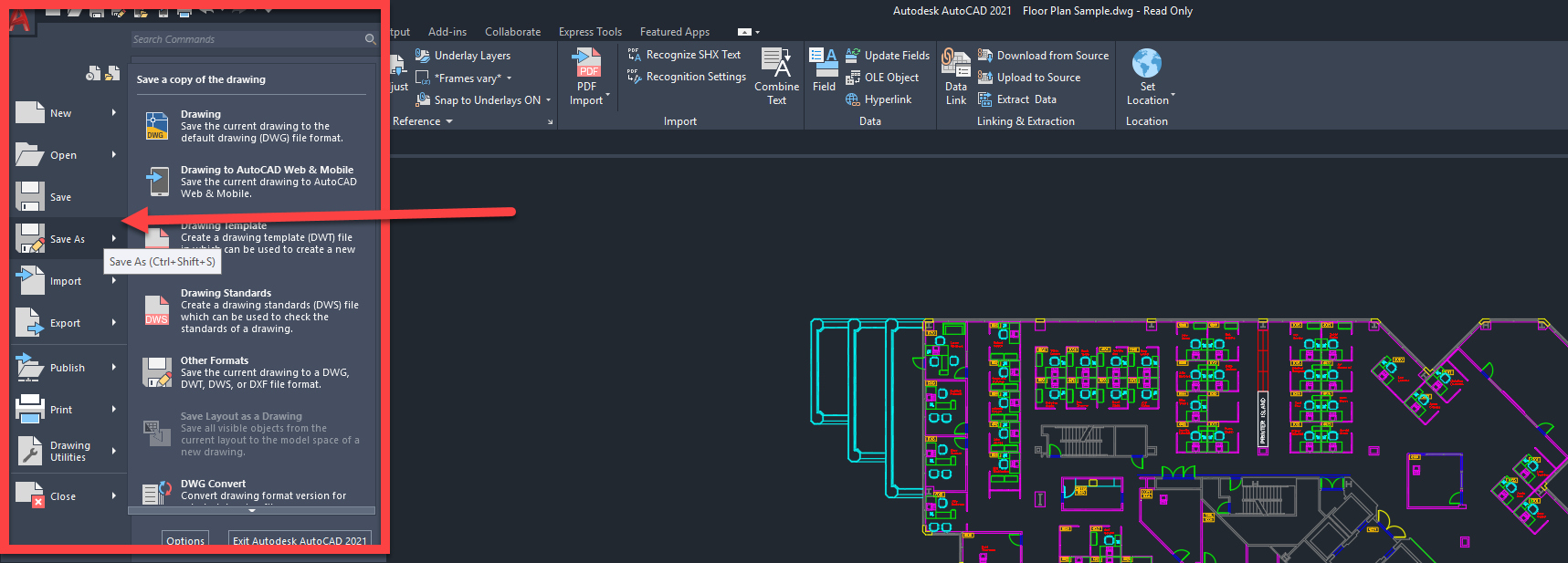
Open your drawing and navigate to the Application menu (the big ‘A’ icon at the top left).
Hover over Save As and then select Drawing.
In the “Save Drawing As” floating window, click on the “Files of type” dropdown list. Here, you will see various options.
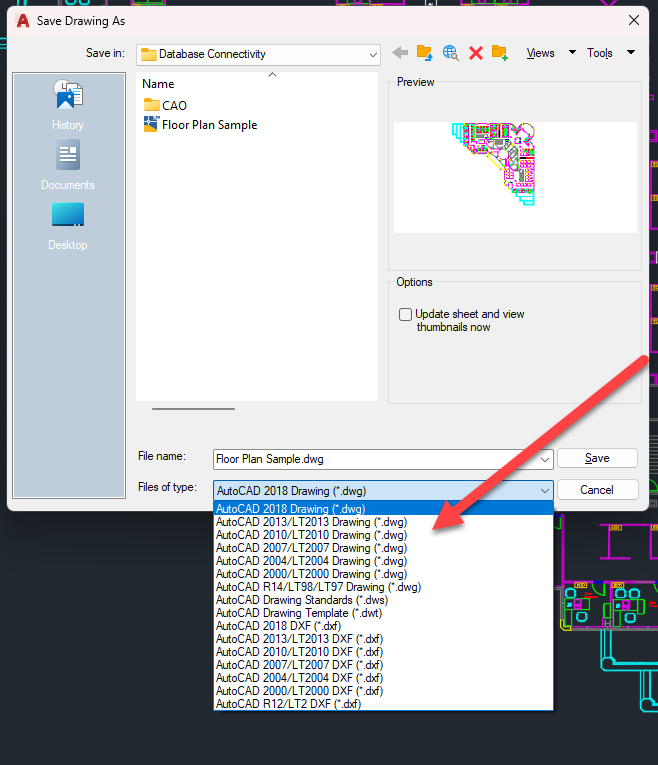
You need to select a version that is older than or equal to the recipient’s software version, such as AutoCAD 2013/LT 2013 Drawing.
Once you have selected the correct format, click Save. Your file is now ready to be opened in the older version.
Also, as a tip, you can use the inbuilt AutoCAD commands to speed up your workflow and improve your productivity in AutoCAD.
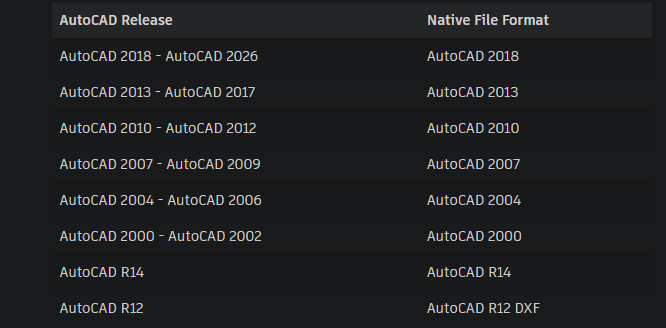
Note: The AutoCAD 2013 format is compatible with all versions from 2013 up to 2017.
The 2018 format covers versions from 2018 to 2013.
Please refer to the image below to understand the compatibility between different versions.
Method 2: Bulk Conversion with eTransmit
The Save As method is great if you want to send over a single file to your colleague.
But it quickly becomes tiresome when you work on a project with multiple CAD drawings and need to send all of them over.
AutoCAD’s eTransmit feature comes in handy for this task.
While it’s primarily designed for packaging projects for delivery, it also acts as a powerful AutoCAD lower-version converter for bulk files.
Find out how:
Open your drawing in AutoCAD. Type ETRANSMIT in the command line and press Enter.

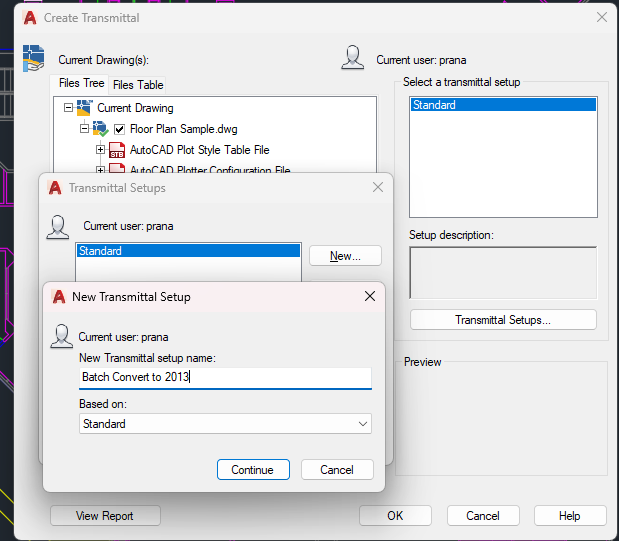
In the “Create Transmittal” floating window, click on the Transmittal Setups... button.
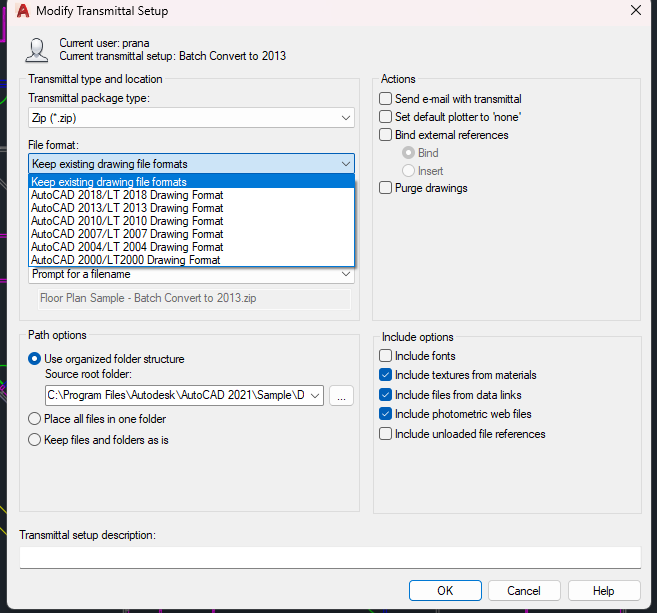
In the next window, click New to create a custom setup. Give it a name like “Batch Convert to 2013” and click Continue. This will open the “Modify Transmittal Setup” window.
Here, under the Transmittal type and location section, locate the File Format dropdown.
Change this to the lower version you require, for example, AutoCAD 2013/LT 2013 Drawing Format, as shown in the exhibit below:
Once done with those settings, click OK and then Close to return to the main Create Transmittal window.
Now, click the Add File… button to select all the drawings you want to convert from your computer.
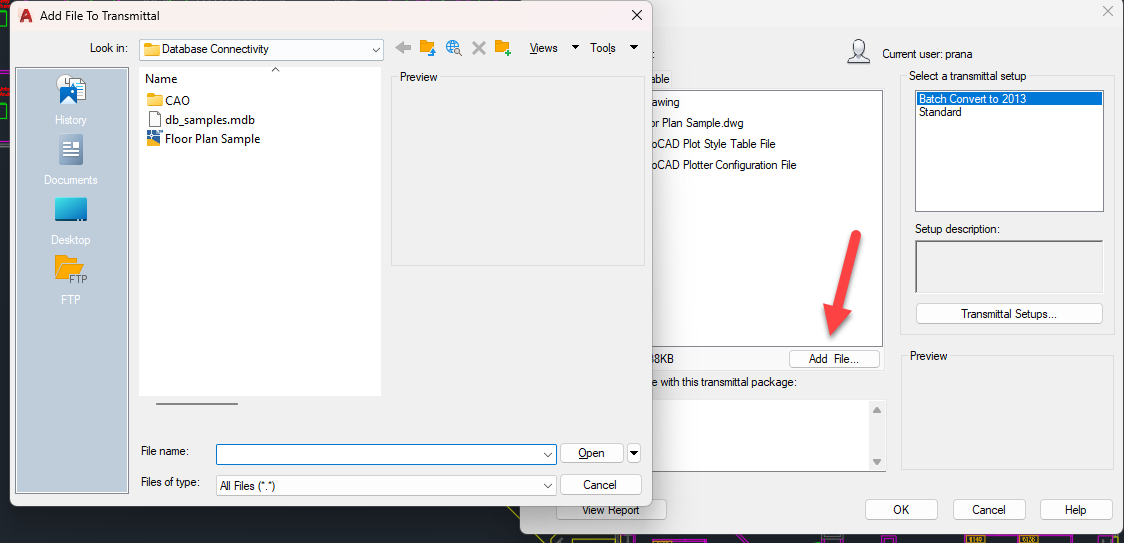
Once all files are added to the list, ensure your new Transmittal Setup is selected in the dropdown, and click OK.
AutoCAD will now process all selected files and save them into a ZIP package.
When you extract this ZIP file, you will find that every single drawing has been automatically converted to the lower version you specified.
Method 3: DWG TrueView (Free Tool without AutoCAD)
What if your colleague sent you the AutoCAD file without converting it to an older format? Or vice versa.
Or what if you don’t have the appropriate version of AutoCAD on your PC to begin with?
Well, lucky for you, for scenarios like this, Autodesk’s DWG TrueView tool exists.
This is a free standalone tool from Autodesk that allows you to view files and, more importantly, includes a feature called DWG Convert.
Launch DWG TrueView and click on the DWG Convert icon located on the ribbon (or via the Application menu).

In the DWG Convert floating window, click the Add file icon (the green plus sign) to load your drawings.
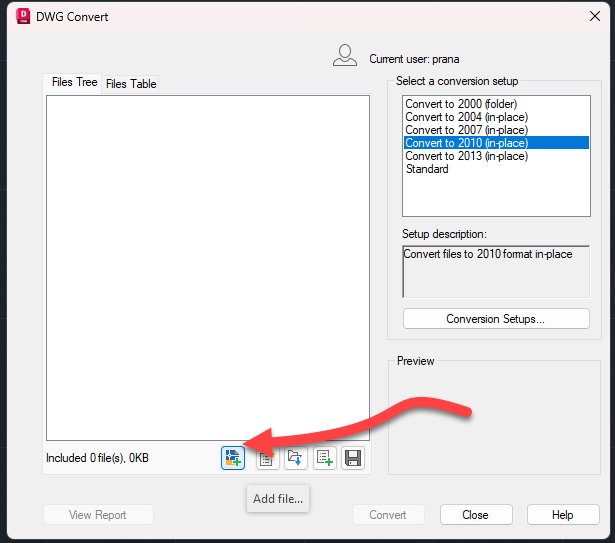
On the right side of the window, you will see the “Conversion Setups”.
You can select a standard setup like ‘Convert to 2013’ or create a new one if you need specific settings.
Once your files are added and the setup is selected, simply click Convert as shown in the window above.
The software will process the files and overwrite them (or save them to a new folder if you configured it that way) in the older format.
This tool is an excellent AutoCAD higher-version-to-lower-version converter that costs you nothing and ensures data integrity.
And since it’s from Autodesk themselves, there are no compatibility issues here either.
Frequently Asked Questions
Here are a few questions that we have encountered from our students and the AutoCAD community at large.
Can I use an online converter to convert my CAD files to a lower version?
Simple answer: yes; Recommended answer: No.
Free DWG tools for converting AutoCAD higher-version files to lower versions exist.
However, for professional work, we’d generally recommend using the official Autodesk tools like DWG TrueView or eTransmit.
These tools ensure that your drawing data, layers, and XREFs are preserved accurately without the risk of corruption or data privacy issues that might arise from uploading proprietary files to third-party cloud servers.
Will I lose data when converting to a lower version?
Generally, the geometry remains intact. However, AutoCAD does not convert newer features in your drawings.
For instance, if you have used features that are exclusive to newer versions (like newer dynamic block parameters or specific 3D objects introduced recently), those objects might be converted into “proxy objects” in the older version.
They will still be visible, but you might not be able to edit their specific properties until the file is brought back into a newer version.
How do I know which version to save to?
A useful rule of thumb is to save to the AutoCAD 2013 format if you are unsure.
This format is highly compatible and can be opened by almost any version of AutoCAD released in the last decade (versions 2013 through 2017, naturally, and all newer versions as well).
Summary
All is not lost if you want to send a newer version of the file to your colleague who’s still stuck using their older AutoCAD license.
In fact, AutoCAD has accounted for it, and using the in-built “Save As” command, you can send over your file in a format that’s suitable for your colleagues’ version.
In a case where you want to send dozens of files over, use the powerful eTransmit feature in AutoCAD.
It’s straightforward and easy to use and lets you package and send over multiple files in the format of your choosing, all at once.
Lastly, in the unfortunate event where your colleague with a newer AutoCAD version decides to play a prank on you and send the file without converting it to a lower version, use the free DWG TrueView software.
It’s compatible with AutoCAD and reduces the risk of you losing any crucial data or information from the file.
If you have any questions, need any further clarification, or have any comments, please just drop them in the comments section below.